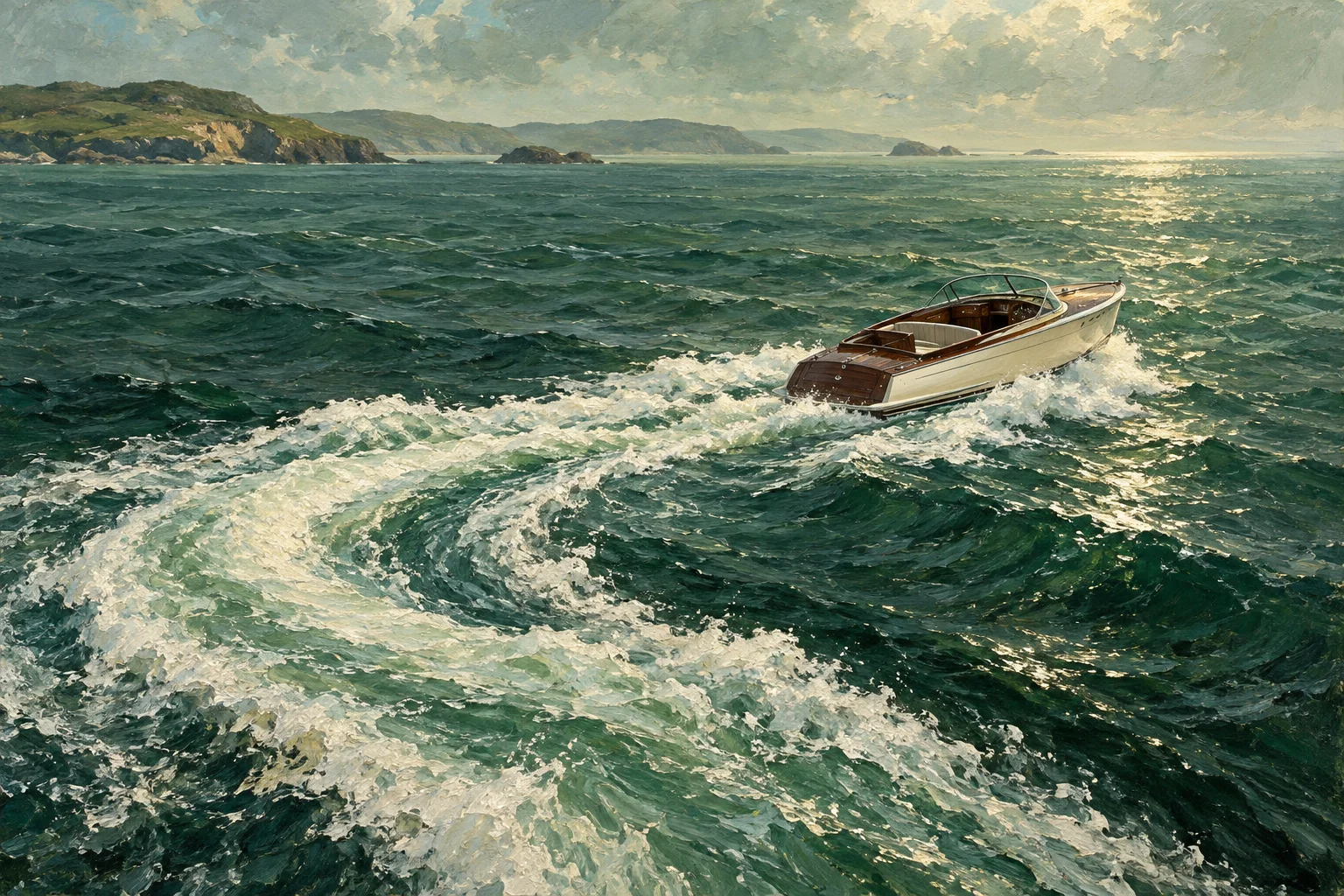
A boat passing through open water leaves an invitation for the eye to follow. White water starts near the stern and opens into the surrounding sea. Even in a still image, that trace suggests a direction and a moment just gone.
Give the water a job
In a close boat portrait, the vessel fills the frame. In a wake picture, space matters just as much. The boat can become smaller, positioned towards an edge, while the water explains the movement. Cropping too tightly behind the stern can remove the part that makes the composition work.
Our artwork Homeward Wake uses that relationship: a pale launch, dark water and a curve of white. It is an AI-created interpretation of a coastal scene, not a documentary photograph of a named boat or location.
Follow the line
When choosing your own photograph, look at where your eye enters the image. A bright curve from the foreground towards the boat can lead you through it. A horizon crowded against the top edge might add tension; a broad sky can make the same water feel calmer. There is no fixed formula, but it helps to recognise what the photograph is doing before cutting it down.
Compare the original image with a temporary crop. Keep the boat, wake and enough surrounding water visible. If the cropped version loses its sense of movement, return to the wider view.
A print for someone who knows that feeling
This kind of picture need not show a recognisable harbour. It can be about heading home, opening the throttle on a clear stretch or watching the water from the stern. Pick the scene that matches the person's connection to boating rather than assuming the most dramatic image is the most meaningful.
Explore motorboat prints, or read our motorboat portrait guide if the picture should be of their own boat.
Published . Still & Wake editorial.